


[Event Report – Special Full Edition] Season 2, 11th In-PersonEvent (42nd Overall) [Nomura Securities × Hedera] "Web3Redesigns the 'Trust' in Finance" — The New Era "FromSecurities to Digital Asset

Held Wednesday, July 15, 2026 Shibuya Web3 University – Season 2 – 11th In-Person Event
(42nd Overall) [Nomura Securities × Hedera] "Web3 Redesigns the 'Trust' in Finance" —
The New Era "From Securities to Digital Assets," Drawn by the Insiders Themselves —
This report is a little different from our usual ones.
Toward the end of the panel, hajimex, President of Shibuya Web3 University, made a declaration to the room:
"Let's translate everything from tonight and publish it on our blog. And in the preparation process, there were many more questions we never got to on stage — let's publish those too."
True to that promise, this is a specialfull edition: it covers every session of the night, plus the discussion points that were left on the other side of the time wall — content shared in the preparation session with our speakers that could not fit into the live program. We believe the information gathered on this one night deserves to be shared with society, at a moment when traditional finance is undergoing a tectonic shift on-chain. It will take you more than twice as long to read as our usual reports. Please take your time.

Why This Night Was Special
The venue: WeWork Shibuya Scramble Square, 45th floor. Doors at 17:00, start at 18:00, admission with a single business card. Capacity of 100, approval-based registration, fully in-person with no online streaming. Every session with Japanese–English interpretation.
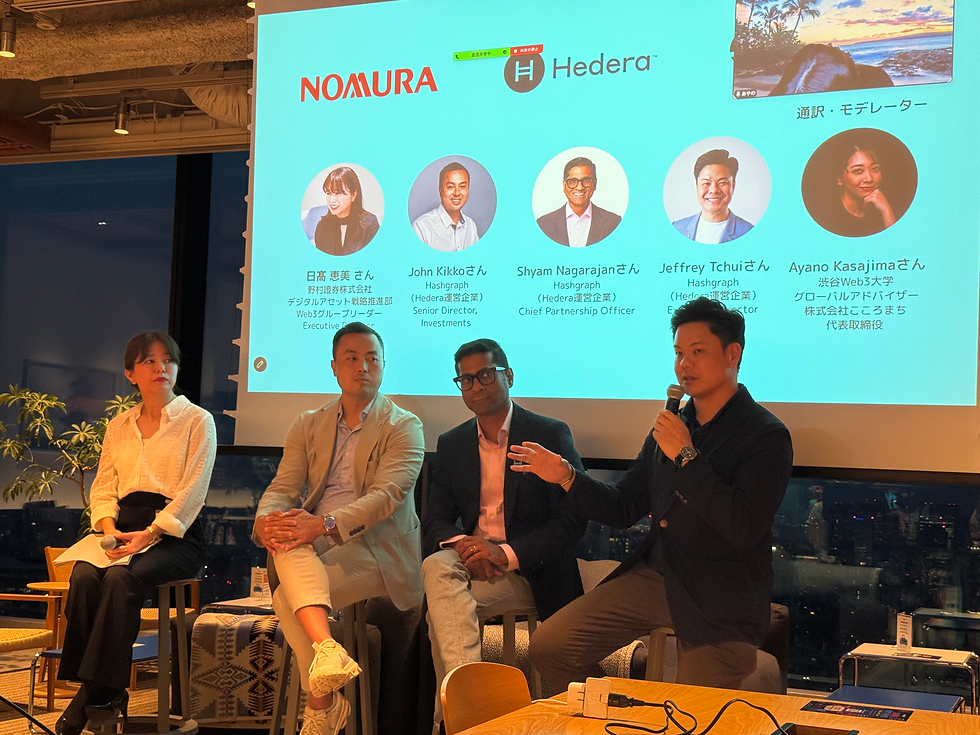
On stage: Emi Hidaka of the Digital Asset Strategy Department, Nomura Securities / Nomura Holdings. And from Hashgraph — the company behind the distributed ledger network Hedera — three senior executives gathered in Shibuya from New York, Hong Kong and Ho Chi Minh City: Chief Partnership Officer Shyam Nagarajan, Senior Director of Investments John Kikko, and Head ofAPAC Jeffrey Tchui.
Hedera's Governing Council counts global leaders such as Google, IBM, Dell — and Nomura Holdings — among its members, each of which operates a network node itself. In other words, this was a night when the new era "from securities to digital assets" was described not by outside commentators, but by the very people building it from the inside. It was the first special collaboration seminar between Nomura Securities and Hedera in Japan, realized through Nomura Holdings' formal approval process.
The event was announced on Peatix, on Nomura's own Web3 media "Web3 Pocket Campus," on the official Hedera Events Page, and on both companies' social channels. For a week before the event, flyers were displayed in the showcase at the 39th-floor entrance of WeWork Shibuya Scramble Square — a corridor passed daily by roughly 6,000 people from 230 resident companies.


Opening — Connecting Hawaii and Shibuya
Taking the microphone first: hajimex, President of the university. This monthly in-person event series, held without fail since its start, has now reached its 42nd edition. He introduced where Shibuya Web3 University stands today — the Create Course, where corporate innovation leads and graduate students gather; the Polish MBA/DBA programs launched this year; and the international MBA with the University of Wolverhampton (UK) opening for applications in September. "We have no intention of running programs just for the sake of a degree. We interview and admit only people who act to change reality," he said, opening the night with his usual intensity.
And this time, there was a first. Ayano-san — Global Advisor of Shibuya Web3 University, CEO of Kokoromachi Inc., and the person who made this collaboration happen — joined via Zoom from Hawaii, where she was staying, serving as both moderator and interpreter. A bilingual professional who spent some 20 years in Hong Kong, she ran the Shibuya stage from across the Pacific. A very Shibuya Web3 University kind of night.
"It started with a call: 'I'm in Hawaii right now, but I have a really good story for you —'" (hajimex)
Keynote 1 | Emi Hidaka (Nomura Securities / Nomura Holdings)
Nomura Securities' View on "From Securities to Digital Assets" — Japan's Frontline of Tokenization
▼Nomura Holdings

"Good afternoon — or good evening? It's still light outside."
With that gentle opening line, Keynote 1 began. After a career in tax and treasury within Nomura Securities' Finance Division, Hidaka-san joined the Digital Asset Strategy Department in April 2023. She leads operational management of Laser Digital, Nomura's overseas digital asset subsidiary, and new business development leveraging crypto assets and stablecoins, as Web3 Group Leader.
Her theme: "Why is a securities firm working on Web3?" She walked the audience through three questions — what is happening in the world, where Japan stands, and what Nomura is aiming for.
The Change in the World — Traditional Finance Has Started Moving On-Chain Hidaka-san organizes the story into four phases.
Phase 1: the arrival of Bitcoin in 2008 and Ethereum in 2014 — peer-to-peer value transfer, and transaction logic implemented in code. Phase 2: DeFi and stablecoins from around 2018 — financial functions like trading, lending and issuance provided in decentralized form, with stablecoins overwhelmingly dollar-based.
Phase 3 — where we are now — began around 2020 with institutional participation and market expansion: crypto ETFs in the US, tokenized money market funds appearing on chain. And from around 2023, the "reconstruction of financial infrastructure" began: transactions between financial institutions being implemented on-chain, with 24/365 operation and partial automation of collateral and settlement.
What caught her attention most, she said, was the news from last autumn.
"Nasdaq filed with the SEC to allow tokenized stocks to be traded on its market. The New York Stock Exchange announced a platform to trade tokenized securities on-chain, 24/365. These were announcements we watched with great interest."
Looking further ahead, she pictures Phase 4 as "Everything Onchain × AI" — all assets tokenized, AI agents trading and managing assets with one another. "I think there is a future in which we develop financial products aimed at AI agents. That is what we are watching."
Where Japan Stands — A Unique Evolution, and Two Stablecoins
Turning to Japan: on the asset side, the security token (ST) market has developed in its own unique way. STs are securities issued and managed using blockchain technology, defined under the revised Financial Instruments and Exchange Act that took effect in May 2020. Cumulative public ST issuance has reached roughly ¥340.4 billion across 85 tokens. And yet —
"The stock market's total capitalization is said to be around ¥1,000 trillion, so this is still small. What's notable is that about 90% of it is real estate — stocks and bonds have not really been tokenized yet. And since STs are purchased in fiat through securities accounts, you can't say the asset side and the settlement side are both fully on-chain. That's what I mean when I say Japan's development has been 'unique.'"
On the settlement side: between 2025 and 2026, Japan saw the launch of two first-of-their kind stablecoins. One is JPYC, based on the funds-transfer framework, with a per transaction cap of ¥1 million and about ¥3 billion issued. The other, launched on June 24 by SBI Group and Startale Group, is the trust-type JPYSC. Issued by a trust bank with no issuance cap, it currently operates in a closed environment without transfers to external wallets, with about ¥10 billion issued. Two stablecoins with distinct designs — and Japan's settlement layer has begun to move.
What Nomura Is Aiming For — An FSA-Selected PoC, and the MOU with Circle For Nomura's own initiatives, Hidaka-san highlighted two.
First, a proof-of-concept with Daiwa Securities and the three megabanks on trading and rights transfer of traditional assets — selected for support by the FSA's "FinTech PoC Hub" (February 2026). Covering book-entry securities such as JGBs, listed stocks, investment trusts and corporate bonds, the project synchronizes interbank transactions to a blockchain in real time, and ultimately aims for simultaneous DVP settlement of securities against stablecoins, linked to the stablecoin infrastructure the three megabanks are expected to issue. "Including the legal questions around the book-entry transfer law, it is a project that calls for careful study and a medium-to-long-term perspective."
Second, the freshly announced memorandum of understanding with Circle.
"The focus is 'on-chain finance' — conducting financial and capital markets transactions on blockchain. On-chain collateral management, fund transfers, FX. And one more thing: taking on the trust-bank functions needed to circulate stablecoins in Japan. That part is a genuine, real-business area of study."
Even more interesting was her point that the work is surfacing needs no one had been able to capture before.
"For example, transactions divided by time of day — the kind of need the existing market conventions simply couldn't serve. With blockchain and stablecoins, we end up rethinking those conventions themselves. I find that genuinely exciting."
"In the Past Six Months, the Tide Has Turned"
Her closing observation was about a change you can feel. At IVS Kyoto two weeks earlier, she had shared the stage with JPYC and Circle — and across other sessions too, "all transactions will move on-chain" was now being said out loud, as a normal thing.
"Actually, when I spoke at Shibuya Web3 University last October, I was asked what future I envisioned, and I answered 'Everything Onchain' — but at the time, I said it rather timidly. This year, we've moved past debates like 'should securities firms handle crypto' or 'should we launch a crypto ETF.' The mood has become 'we're doing on-chain finance, right?' In the
past six months, the tide has turned. I feel it strongly."
"On-chain finance is a rebuilding of financial infrastructure itself. And if we're going to build something new anyway, I want to build something better."
She ended with an invitation to the room. "This is not something any single financial institution can build alone. If you have ideas — anything at all — I would love to create use cases together. Please reach out." That, she said, was the thing she most wanted to say today.

Keynote 2 | Shyam Nagarajan (Chief Partnership Officer, Hashgraph)
Building a Trusted Digital Economy
▼Hedera
▼Hashgraph

Next to take the microphone: Shyam Nagarajan, Chief Partnership Officer of Hashgraph, the company behind Hedera. Formerly of IBM, he brings deep expertise in governance and compliance. The talk was delivered in English, with Ayano-san's consecutive interpretation.
From the very start, the central thesis of the talk was on the table:
"Trust is not a feature you layer on top of financial infrastructure.It is the basic architecture of the technology itself."
The Problem — Infrastructure Has Not Kept Up
Financial markets run on trust. Every transaction, settlement and collateral arrangement assumes the system behaves predictably and the record is accurate. But the infrastructure has not kept up with that expectation — settlement still takes days, not seconds; post-trade reconciliation is largely manual, slow and costly; cross-border payments route through correspondent banks, adding cost, delay and opacity; and regulatory expectations keep rising globally.
"The question is no longer whether to modernize. It is who you can trust to do it with." The Opportunity — The Market Is Already Moving
The numbers rolled out. More than $34 billion in tokenized assets already on-chain. A projected $16 trillion tokenized asset market by 2030. 86% of institutional investors already holding some form of digital asset exposure. Total value locked in tokenized assets up 25x since 2023. And Japan increasingly present in this picture.
How Hedera's Trust Is Constructed
Shyam-san positioned Hedera as "the trust layer of the digital economy, built from the ground up for regulated industries," and unpacked how that trust is structured.
Accountability over anonymity. When things go wrong, who is responsible? Most distributed networks cannot answer that question. Hedera's governance makes it explicit: a council of 30+ leading global organizations — Google, IBM, Nomura, Standard Bank and others — that don't merely sponsor the network but run it themselves: operating nodes, participating in consensus, carrying reputational responsibility. Every member holds an equal vote; no single entity, Hedera included, can dominate. This is not a claim. It is structural.
Fairness by design. Anyone can submit transactions — no whitelisting, no approvals, no gatekeepers. Fees are fixed and predictable in US dollars: no gas volatility, no front-running, no MEV. Transactions are ordered fairly by time of arrival; no one can jump the queue. The
codebase is open source under the Linux Foundation Decentralized Trust, auditable by anyone.
Eight years in production. "Don't believe what I say," Shyam-san smiled, pointing to the public network monitor where anyone can verify the numbers. More than 71.5 billion lifetime mainnet transactions — the most of any enterprise DLT network. A registered maximum of 8,497 TPS. More than 9.7 million accounts. In production since open access in 2019, with no major security incident. These are not projections. They are track record.
Live Use Cases Today
A series of production cases in financial services followed.
Aberdeen × Archax × Lloyds (UK): Traditional FX collateral management means slow transfers, settlement delays and operational inefficiency — limiting capital mobility and raising counterparty risk. In this landmark transaction, units of an Aberdeen money market fund and UK government bonds were tokenized, then issued, transferred and secured on Hedera by FCA-regulated Archax, and used as collateral for FX trades executed by Lloyds. It proved that tokenized assets can function within existing regulatory frameworks — no new legislation, no special exemptions. Collateral can be recovered immediately after a trade and reused for the next one; real-time collateral mobility, in a market measured in the trillions.
Shinhan Bank (Korea) × SCB TechX (Thailand) × a leading Taiwanese financial institution: A pilot delivering real-time settlement and FX-rate integration for cross-border remittance across Korean won, New Taiwan dollar and Thai baht, using Stablecoin Studio. Settlement reduced from days to seconds. Because the framework is EVM-compatible, any EVM-based stablecoin issuer can join. "Going forward, we hope to extend this to Japanese stablecoins such as JPYC and JPYSC as well."
Project Acacia (Australia): A joint initiative of the Reserve Bank ofAustralia and the Digital Finance CRC. Australian Payments Plus — itself a Hedera Council member — participated in verifying the movement of digital currency between the Hedera public network and HashSphere, Hedera's private network. An Australian dollar stablecoin (AUDD) was issued on Hedera and chosen for multiple wholesale settlement use cases. Regulatory control without sacrificing interoperability with the broader ecosystem — the answer that many financial institutions in the room will need.
Beyond finance, he also touched on Accenture and EQTY Lab's verifiable governance modules for public-sectorAI, and Dropp's micropayments (Dropp is also a service provider for FedNow, the US Federal Reserve's payment service).
Why Here, Why Now
"Structural advantage in financial infrastructure is built, not inherited. The institutions that shaped SWIFT, the clearing networks and ISO 20022 held their advantage for decades — because they moved early. The standards for tokenized financial infrastructure are still
being written. There is no dominant player yet. In Japan, we have been in dialogue with the FSA, and conversations about pilots are beginning."
And then, the line most likely to be quoted from this talk:
"First movers will shape the rails. Everyone else will run on them."
Three strategic focus areas going forward: tokenization at institutional scale, supported by the Asset Tokenization Studio; AI Studio and the Agent Kit, for an era in which AI agents execute financial transactions autonomously; and CLPR — the cross-ledger protocol that cryptographically connects private HashSphere networks, the Hedera public network and other public chains, with no bridges. "We do not believe liquidity will consolidate onto a single network. The future is one in which all these networks and assets interoperate. Hedera will be the connective tissue."

Panel Discussion | Nomura Securities × Hedera — Drawing the New Era "From Securities to Digital Assets," Together
Panelists: Emi Hidaka × Shyam Nagarajan × John Kikko × Jeffrey Tchui Moderators: hajimex × (from Hawaii) Ayano-san

Just before the panel, hajimex tossed John-san a plain-spoken question: "Is this like Wise going on-chain? International transfers take days through a bank; Wise gets it down to hours. If that goes on-chain —"
John-san answered instantly: "Exactly. Not hours anymore — seconds. That's going to be real."
With the room warmed up, the 45-minute panel began — extended from the usual 30 minutes to make room for interpretation. The main course of the evening.
Where Do the First Use Cases Start?
Ayano-san's first question went to Hidaka-san: "You spoke about wanting to rebuild the financial system. From a securities firm's perspective, where do on-chain use cases begin?"
"We want to start between financial institutions. FX, and repo — repo transactions between tokenized JGBs and stablecoins, not limited to USDC but including Japanese stablecoins. From there, we'd like to expand. That said, I do believe the destination is Everything Onchain — so if each of you grows use cases in your own field, and they end up connected on-chain, that would be ideal."
Two Patterns of Going On-Chain — John Kikko's Framework
Then to the infrastructure side: John-san. Based in New York, with more than 15 years across Wall Street banks — including, in fact, a stint at Nomura — and most recently in Fidelity Investments' digital assets business, he knows both traditional finance and Web3
from the inside. After a laugh — "my Japanese is broken, so this will be chanpon (a mix)" — he delivered the core in English.
"Things are moving in two patterns. One: you keep the legacy systems, represent the security as a token, and settle that on-chain — a digital twin. But it still needs to speak to legacy systems for reporting, audit and compliance. And now we're moving into the second pattern: security tokens that are native on-chain from the beginning. For that, the market structure itself needs to change. In the US, the transfer agent has to be on-chain; reporting has to be drawn from the blockchain to the reporting agencies. All of that tooling needs to happen — and we are building it right now. It requires everybody in the marketplace to agree on standards."
For a 100-Year-Old Firm: Extension, or New Market?
Ayano-san turned back to Hidaka-san. "Nomura is a company with more than a century of history. Are digital assets an extension of the existing business — or something else?"
"I think of it in two dimensions — and as two tactics," she replied.
"First: delivering crypto-related products safely and securely to our existing clients. As crypto assets move into the Financial Instruments and Exchange Act framework, incorporating them as one asset class among many is, I think, part of our mission. And beyond that, the second is using blockchain as infrastructure to do something new — in capital efficiency, in expanding capital markets as a whole, including stablecoins. We always run on these two wheels."
From Two Frontlines, Hong Kong and Vietnam — Jeffrey Tchui's View
Jeff-san, Head ofAPAC, moves between two contrasting bases: Ho Chi Minh City and Hong Kong.
"I've been in this ecosystem since around 2020–21, so I've watched Hedera's evolution over many years. My work in Vietnam is early-stage capital markets infrastructure — using Hedera to leapfrog legacy systems. My work in Hong Kong is taking a mature capital markets infrastructure and modernizing it. I'll be honest: back in 2020 I built a tokenization platform with a council member company on Hyperledger Fabric — very common in Japanese banking infrastructure too. The problem is, it doesn't scale. So the question becomes: how do you use the best technology we have now, for the right purpose, in a market like Japan? How do you use technology like hashgraph to modernize Japanese infrastructure? That's what I work on."
What's Happening in America After the GENIUS Act
To Ayano-san's question about how different markets are receiving all this, John-san said "let me try this in Japanese" — and conveyed, vividly, the air in Washington and on Wall Street.
"In America, the moment the GENIUS Act — the stablecoin law — passed, the megabanks went into a rush. There's a massive push to issue stablecoins and tokenized deposits. Why?
Because fintechs and companies like Robinhood are eating into the existing institutions' business at incredible speed. The disruption risk is too high to sit still."
"Right now in Washington DC, the CLARITYAct — the market structure law — is being debated. What's interesting is the posture: the banks are saying 'let's go a bit slower, give us two or three years to catch up,' while the crypto industry is saying 'no, no — let's get regulatory clarity fast.' And once America fires the starting gun on stablecoins, the world can't sit still. 'We can't afford to lose' — that's how the whole world feels."
He then went deeper into what institutions actually require of infrastructure.
"If you're only moving collateral a few times a day, today's Hyperledger-type systems are fine. But we're heading into the era of real-time collateral exchange. Market prices move constantly, so to push counterparty risk toward zero, collateral has to move in real time. Our private network can do more than one million TPS, with zero fees; the public network has fixed, dollar-denominated fees. And we've achieved interoperability between private and public, private and private, public and public — without bridges. Bridge-related hacks have been one of crypto's biggest risks, and we spent years thinking about how institutional players could use this safely. Right now I'm in New York having many of these conversations with major institutional investors."
Japan's Caution Is Changing
Asked about the PoC with the FSA, Hidaka-san deferred politely — "the initiative itself is what I described earlier; details another time" — and instead shared an unforgettable personal experience about the change in Japan's posture.
"Last summer, I went to New York on a private holiday. It happened to be the first time an Ethereum conference was held in New York, and I paid my own way to attend. In the old America, the SEC chair had called Ethereum a security, and people in traditional finance wouldn't even talk about it. And yet at that venue, people from established financial institutions were saying, forcefully, 'we see Ethereum as financial infrastructure.' In that moment I thought: America is going to change."
"Japan has been called cautious, but I think that is changing. I suspect the regulators and the political side also feel the urgency of how overwhelmingly fast things are moving on chain in the US, and that is what's behind the current momentum."
Question from the Floor ①: Does This Work for Manufacturing? — Data Integrity and Timestamping
Then the dialogue opened to the floor. The first question came from a manufacturing professional: "About eight years ago I studied the IBM–Maersk logistics project. Are there examples of manufacturers using Hedera for data integrity, timestamping, or approval records?"
Jeff-san answered immediately. "Remember the 71.5 billion transactions on Shyam's slide? A very large share of those is attributable to one specific project by Avery Dennison. Look inside your Uniqlo — the tag, the NFC chip, the barcode or RFID. The attestation of the manufacturing of that garment was put on-chain with this technology. From garment provenance, there are ambitions to extend into ESG and sustainability — carbon credits and offsets based on how materials are retired or recycled."
John-san layered on the gold example. "There's a very large Japanese trading company doing tokenized gold, and plenty of tokenized gold issuance globally. But what if we actually solve problems with this technology? There are gold mines around the world — especially in Africa and Central Asia — that need financing for the gold before it becomes gold. It takes six to twelve months before the miners get paid, through refining and standardization. If you track and timestamp on a blockchain, you can prove to banks — at an early stage, through the entire life cycle — that the raw material is on a shipment, that there is insurance, that there is standardization, all on-chain. So banks can finance earlier. It's a small use case, but this is the world we're moving to. At Hedera, we're not trying to get a new token moving up and down and get everybody excited. We are super-focused on solving real problems with this technology."
And one more from Jeff-san. "Think back to 2019–2020 — COVID. There was a project in the UK for the AstraZeneca vaccine. Its temperature threshold was extremely tight; exceed it in transit and the vaccine is invalid. One company used Hedera as the public attestation to show the NHS that the vaccine was still valid when it arrived. Not much volume — but high impact."
Question from the Floor ②: "So What, in the End,Is Hedera's Message?"
The second questioner was Justin-san of Crypto Garage. From the standpoint of a long timer in this industry, the question was refreshingly direct: "Over the years I've heard IoT, high throughput, DeFi, and lately RWA. There are so many chains. What should we take away from today about Hedera?"
Shyam-san took it head-on. "When the founders envisioned Hedera, they constructed it as a public good network: enterprise-grade, regulatory-compliant, most useful for enterprise usage. The world and the market have changed since Hedera went live on mainnet, but that
ethos has continued — from ESG, data integrity and traceability all the way to real-world assets and today's focus on tokenization. The market evolved, our technology evolved, and what we are did not change. And now, finally, the market is mature enough to adopt and leverage this enterprise-grade infrastructure. The future is not crypto volatility and trading. It is truly about using the infrastructure for your organization's benefit — new revenue, new markets, new customers."
John-san reinforced it in the language of Wall Street.
"I've spent my entire career in finance. Fifteen years on Wall Street, a stint at Nomura, and before this I was at Fidelity Investments in the digital assets business — my job was to
understand what banks and regulated financial institutions would actually use. Ethereum, Solana, Canton, Stellar — there are so many. So how do you differentiate? Think about it. On a permissionless chain, fees can move 1,000x just because a meme coin launched somewhere in the ecosystem. What happens in a collateral-mobility use case when everyone tries to sell because the market crashed — and the chain slows down and fees go 1,000x? What happens in an agentic economy, with an infinite number of agents moving micropayments, if you charge a hundredth of a penny today and five dollars tomorrow? It's not usable."
"And consider this: if a bank's monthly blockchain fees are, say, $10,000 — who exactly are they paying? Are they in the US, in Japan, in a sanctioned country? You can't prove it. So we designed the network so that the validators are known, trusted, publicly traded companies — accountable, with boards of directors to answer to. We built the governance structure for a future that requires accountability. That's why we chose permissioned validators."
And then came the line of the night.
"Recently the CEO of a B2B wholesale travel platform told me: 'I looked at everybody, and I chose to build on you — because I want to build a sustainable business, and I want the fixed fee.' As he builds his business, he wants to predict his margins; he doesn't want the blockchain to be a variable — the business itself is dynamic enough. So to summarize: we want to be as boring as electricity. You plug in, and it works. We want everyone to use it, we want it reliable, safe, secure — the kind of thing you'd feel OK putting your most important machines, your life support, on."
Laughter, and deep nods. Ayano-san's "the interpreter is having a hard time over here" got its own round of laughter.
Question from the Floor ③: Japan Strategy, and Startup Support
The final question came from a builder with a development company in Vietnam, currently working on AI-agent security on Solana: "What is your strategy in the Japanese market — and do you have programs to support startups?"
Jeff-san: "I look after everything from Japan to Pakistan down to New Zealand. Hedera's technology is about 90% applicable in most jurisdictions; what's missing is the last mile, the 10% of localization — and we do that with partners. Partners like you. We have hackathons for builders, and investment opportunities through the VCs and venture funds inside our ecosystem."
"And Japan is a critical market for Hedera — because Japan is the trusted capital market of this region. Every use case I see across Asia Pacific — trade finance, capital markets, tokenization, infrastructure modernization, even agentic commerce — gravitates back toward Japan somehow. Even when we build financial market infrastructure in other developing nations, yen-denominated investment draws intense interest. Positioning Japan as the capital markets hub that supports Asia-Pacific development, with Hedera and Hashgraph infrastructure as the interlink — that's the strategy outside Japan."
"Inside Japan: partnering with local initiatives issuing yen-denominated stablecoins; working with local exchanges as regulations modernize; transformational use cases in sustainability and AI; and Japan's core economic strengths — intellectual property, the distribution of anime and content, in Japan and beyond. Another council member is Hitachi — I'm ex-Hitachi Data Systems myself, three years — so RWA around data centers and AI is another area. We don't have a Japan representative yet, but we're working with local partners to grow our footprint. We're a lean team, and we don't splash capital around to make a big splash — because we're here for the next hundred-plus years. We know our technology is very good. Some of these things take longer, but we're committed: realistic opportunities, local partners, long-term relationships."
One Last Word — Toward the Next Five Years
To close the panel, hajimex asked each speaker for one word about the future.
Hidaka-san: "No one knows what things will look like in five years — the world changed this much in just six months. But if we keep at it steadily, I do think we'll basically reach the state of choosing: 'existing rails, or on-chain — which one?' As for me, I'm working toward that future of Everything Onchain, starting today. I hope we can work on it together."
John-san: "I learned an enormous amount about Hedera today (laughs). Since 2017 the theme has always been 'the institutions are coming.' From here, it truly accelerates — the disruption risk is too high to sit still. And the acceleration ofAI is going to collide with blockchain. AI governance will be anchored on-chain; agentic commerce will use stablecoins. AI news is going to become crypto news. This is absolutely not financial advice (laughs) — but even in this bear market, I personally think the next step ofAI will light up the crypto market again."
Jeff-san: "Blockchain is a transformative technology — and the key word is transformative. It's meant to be applied to transformative use cases, beyond meme coins and price speculation. The potential in the Japanese market is immense, and you could be the leaders of this transformative work. Japan is the center of excellence for interoperability — economically and culturally — in this region. Let's collaborate and grow together in Asia Pacific."
Shyam-san: "I have to say this, because marketing will kill me if I don't — Hedera is the trust layer for the digital economy. If you take one thing home tonight, take that."
And from Hawaii, Ayano-san: "This February, at a financial conference involving the FSA, a friend messaged me: 'I met someone from Hedera.' That was the beginning of everything. From there I connected with Thinzar-san, and being able to introduce this event — I'm truly happy." The room gave the person who spent two months making this night real a huge round of applause.
[Special Feature] Beyond the Time Wall — What John Told Us in the Preparation Session (The Complete Print Edition)
Even at 45 minutes, the panel could not exhaust every thread.
On July 4, ahead of the event, we connected Tokyo, New York and Hawaii on Zoom for a preparation session — and John-san came with strikingly concrete answers to all seven planned questions. The parts that never made it onto the stage are simply too valuable to leave in a folder, for anyone tracking where on-chain finance stands today. Here, we reconstruct them in John-san's own voice — the complete print edition.
The Resolution of "Going On-Chain" — Embedding KYC in the Token Itself
The two approaches — digital twin and native issuance — were covered on stage, but the preparation session went a level deeper.
"When an asset goes on-chain, it means the record of ownership and economic rights is managed directly on a distributed ledger. In the digital-twin case, custody of the security remains with the trust bank, and the blockchain is used only for settlement and transfer. The token can move between wallets and interact with smart contracts — for example, as collateral for stablecoins. In native issuance, there is no off-chain counterpart: ownership, economic rights and reporting all live on-chain."
"And on the Hedera mainnet, KYC data can be embedded directly into the token itself. Regulated financial institutions can execute operations like mint, freeze, burn and wipe while complying with local securities law. That design — the ability to respond to regulators' requirements — is exactly what builds trust with regulated institutions."
"One more thing. Transaction costs are always fixed in dollar terms and do not fluctuate even when the network is congested. That is an important difference from Ethereum and Solana — and for institutional investors, it is critical." — On the night, this point blossomed into "as boring as electricity." Its original form was here.
The Geopolitics Behind the GENIUS Act
On regulation, too, the preparation session carried more context.
"In the US, the Trump administration and the CFTC and SEC have taken a pro-innovation stance, hurrying to build clear and fair rules so that capital, talent and new business grow in America. On stablecoins, it is the national-security question — 'who will be the future buyers of US Treasuries?' — that is accelerating the GENIUS Act framework. This is not merely financial regulation; it carries a geopolitical context. Behind every country's race to build digital-asset rules is the same economic and security motive: attracting capital and talent to your own market."
What FinancialInstitutions Actually Require
"What we hear consistently from banks around the world: privacy, enterprise-level resilience, quantum resistance, and known validators. And many institutions want private
chains rather than public ones, for full control over node operation and data privacy. That is why Hashgraph offers a hybrid: the private network, HashSphere, together with the Hedera public mainnet."
"There are also multiple layers of in-transaction privacy: a 'confidential' mode, where transaction details are disclosed but the parties are anonymous, and a 'fully private' mode, where neither the parties nor the contents are visible. HashSphere, which we offer to Japanese financial institutions, interconnects with any public chain without bridges and is fully EVM-compatible."
Japan's Caution Is Not a Weakness
"Japan tends to take a careful, steady approach — and I see that as a strength, not a weakness. The fact that a global financial institution like Nomura participates as a Hedera validator is itself a testament to trust in the Japanese market. Building a sustainable ecosystem after verification and confirmation of safety — the direction Japan is aiming for is, over the long term, a very healthy one."
The Market Five Years Out — Equities Decomposed into Bundles of Rights
And the answer to the final question — how the digital asset market changes over the next five years — was the highlight of the preparation session.
"We started with the tokenization of fiat — stablecoins — and money market funds, because their product-market fit is extremely strong: cross-border settlement, and stable collateral for lending markets. Next come tokenized commodities such as gold. Assets that could only trade in futures markets, because physical delivery is so difficult, gain portability, divisibility and collateral liquidity through tokenization — creating new financial markets."
"Over the next five years, expect far more innovation. For example: tokenized equities decomposed into individual economic rights — price rights, dividend rights, voting rights, lending rights. The tokenization of intellectual property and royalties. The tokenization of access rights to events and activities. Products that never existed in traditional finance will appear one after another."
"And beyond that: using blockchain to verifyAI models and the computing behind physical AI, and using tokenomics to incentivize the collection of the high-quality data humanoid robots need to learn. A good example already exists today — prediction markets. A user betting on the World Cup has no idea the back end runs on crypto. That is what will become normal across many new markets."
"Blockchain is evolving from a 'casino' into infrastructure that works quietly in the background. We are entering an era of new financial products and use cases expanding on a scale we have never seen."
— "As boring as electricity" on stage; "infrastructure that works quietly in the background" in preparation. Two phrases, one from the spotlight and one from the workroom, pointing at exactly the same spot.
Group Photo & Networking — "Say it with us: Web3!"
After the panel, our traditional group photo — with Ayano-san joining from Hawaii on screen. "Sei-no — Web3!"

The networking session from 19:50 carried far more heat than 40 minutes could hold. A line of business cards formed around Hidaka-san, answering her call to "build use cases together"; around the three visitors from New York and Hong Kong, circles of English, Japanese and cheerful chanpon kept forming — a scene that made it tangible: this is where the new era "from securities to digital assets" actually begins. Afterwards, speakers and the Shibuya Web3 University crew headed to the after-party♪

Closing Thoughts — "Trust" Can Be Redesigned
That night, four people arrived from different places and stood on the same point.
Hidaka-san's "if we're going to build something new anyway, I want to build something better." Shyam-san's "trust is not a feature — it is the architecture itself." John-san's "as boring as electricity — something everyone can safely plug into." Jeff-san's "a transformative technology deserves transformative use cases."
The vocabulary differed; the point did not. The "trust" of finance has, until now, been secured by an accumulation of people, paper and time. The era of redesigning it through code and governance structures has moved past proof-of-concept and into the discussion of market infrastructure itself — and the insiders building it say, in one voice, that Japan is a critical market, extending a hand: "let's build use cases together."
What Shibuya Web3 University has held onto for four years is the belief in "technology for people and society," not "technology for technology's sake." Beyond these six months in which the tide turned, the choice between existing rails and on-chain — "which one?" — will not belong to financial institutions alone. Every single person who walked into the 45th floor that night with one business card is a party to that choice.
First movers will shape the rails. Everyone else will run on them. — So, which side will you stand on?
────────────────────────────────────────
The views expressed in the talks and remarks in this report are those of the individual speakers and do not represent the official views of their organizations. Nothing in this report constitutes a recommendation for any specific investment decision or action.
────────────────────────────────────────
【Information】
Recordings of our events are available in the archive for members of the free Study Course. Add us on LINE and sign up via "Study Course Application" in the bottom-
left menu. The latest session is uploaded one to two weeks after each event. More than 300 people currently use the Study Course.
Shibuya Web3 University


Comments